Monday, October 23, 2006

Sermon Notes October 22, 2006

A long time with God

Read Amos 2:4-16


I don’t know all the reasons that have brought you here this morning. Perhaps some of you have come out of habit. Perhaps it was to see some friends. Maybe you want to spend some time with God here is this sanctuary.

When the prophets of old spoke to Israel their deep desire was that the people would remember who they were and spend some time with God. The prophets complained about the ways in which the people demonstrated that they were lost. They ignored the poor, and they overindulged their desires.

The prophet reminds them of their roots, that it was God who led them for forty years in the wilderness and that while the people believe that they can go their own way, without being God’s people they will find that their life becomes heavy. Their self reliance, the strength that they depend on will do them no good.

Forty is an important number in the Bible. It represents a generation, it represents a time of change. Forty is a long time and it is the time that God desires.

Not only does God desire that time, I believe we desire that time with God. Our problem most often is that we fail to recognize our time with God. God is with us in every moment, every breath, every sunrise, every love song, is a moment spent with God. We often fail to recognize that which we really need. We worry about the bills, about politics, we worry about all sorts of things that are not life giving. Sometimes in our worry we create false ideas of strength. We might believe more money will solve our problems, or voting for a different political party will make everything better. When what the prophet is really telling us is that we simply need to spend more time with God.

Monday Read Exodus 34:27
Moses spent 40 days with God on the mountain as God gave the law of the covenant. Are there moments you can remember that you spent with God where you were given some wisdom in a difficult situation?


Tuesday Moses spent a lot of time with God on Mt. Sinai. Where do you like to spend time with God? Do you have a sanctuary in your home? Create a sacred space in your home today.

Wednesday Read Matthew 4:1-11
Jesus goes to the wilderness for 40 days following his baptism. There in the wilderness he is tempted with bread, arguments about faith, and power. What temptations do you live with? How do you answer the tempter?


Thursday We all face temptations. What is your hearts desire in for your relationship with God? What do you need to let go of to make room for a deeper relationship. Write down something you must give up for that relationship. How will you give it up?

Friday I Kings 19:4-14
Elijah runs away. His life is at risk so he seeks shelter. An angel of the Lord ministers to him for 40 days. As he waits for God, a great wind, an earthquake and fire come by but Elijah doesn’t find God in these forces. Where Does Elijah find God?

Saturday Is there a place, a time when you can experience true silence and be with God? How much time will you give to God in that time of silence?

Sunday Attend worship at LUMC

Making Room

LUMC has been great in the past three years in making room for others. We have reclaimed three rooms that were being used for storage so that they are now available for classes, youth meetings and choir practices. This meant that some groups had to surrender this space. I think it is fantastic how graceful we have been in making these and other physical changes to make room for others to participate in the ministry of LUMC.

I believe that we are being called to continue making room for others not only in physical space but also in how we relate with one another. A year and a half ago I attended a seminar led by Alice Mann who wrote a book about congregations in transition. The following notes come from her book “Raising the Roof.”

Between sizes, churches that have been growing steadily tend to hit an attendance plateau. Often they notice a mismatch between their flat year to year attendance chart and their other measures of growth – the number of visitors, members, or dollars contributed may keep increasing while attendance remains stuck.

The movement from family size to pastoral size involves a change in the way a system centers its life. . . . When attendance exceeds 50, the congregation encounters a crisis – the unbroken circle of members no longer works well as the defining constellation of the congregation’s life. Members experience distress because they can no longer keep track of all the relationships. . . . In order to grow further, the system must allow the development of two or three different networks of family and fellowship

We are facing significant change in how we create space for others. The reality is that most folks will not know everyone at the church. Our challenge is to continue to build relationships with one another as we continue on our spiritual journeys.

One sign of this change is that instead of one Sunday evening class we now have two. Instead of One Bible study group we have three groups meeting on two different days. The networks are developing. While we continue to grow I encourage you to find ways that you can build new relationships and to make room for others.

Tuesday, October 10, 2006

Sermon Notes October 8

Earth, Sea, and Sky

Psalm 8

"The Natural World" from the United Methodist Book of Discipline

All creation is the Lord’s, and we are responsible for the ways in which we use and abuse it. Water, air, soil, minerals, energy resources, plants, animal life, and space are to be valued and conserved because they are God’s creation and not solely because they are useful to human beings. God has granted us stewardship of creation. We should meet these stewardship duties through acts of loving care and respect. Economic, political, social, and technological developments have increased our human numbers, and lengthened and enriched our lives. However, these developments have led to regional defoliation, dramatic extinction of species, massive human suffering, overpopulation, and misuse and overconsumption of natural and nonrenewable resources, particularly by industrialized societies. This continued course of action jeopardizes the natural heritage that God has entrusted to all generations. Therefore, let us recognize the responsibility of the church and its members to place a high priority on changes in economic, political, social, and technological lifestyles to support a more ecologically equitable and sustainable world leading to a higher quality of life for all of God’s creation.
2004 Book of Discipline, Social Principles ¶160

A few years ago I went on a mission trip with the Bishop and other clergy from the PNW to Mexico. We spent a few days in Mexico City. The city is one of the largest in the world with an estimated population of about 17 million people and it is generally regarded as one of the most polluted cities in the world as well. The city is surrounded by mountain range’s that trap the air around it. The congestion of cars and people can be overwhelming. What became abundantly clear to me is that Mexico (and the world) needs the United States to create solutions for many of our environmental problems. We have the scientific and economic resources. We have the ability, but do we have the will?

The writer of the Psalm knew that our health our life depended upon worship and our spiritual health. We are called to live in balance and recognition that all that we have belongs first to God.

Our failure to live in harmony with our environment is a spiritual problem.

One Factor of this spiritual problem is our devotion to individualism, personal freedom and in the church an emphasis on personal salvation. We have taken individualism to extraordinary heights. We don’t attend concerts to listen to music, we download music on “ipods.” You can’t travel in our population areas without a car. Can you imagine being a tourist in Los Angeles without a car? You couldn’t get anywhere. There is no subway to Disneyland, no one WALKS in LA.

Many churches have shifted the emphasis of the great commission to “Make disciples of all nations,” and we have turned it into a commission of “Make disciples of some people.” We must be more than a collection of individuals who have accepted Jesus Christ as their personal Lord and Savior. We must be about the creating of that helpful phrase that Rev. Dan Gerhard brought to our attention a few weeks ago, “The Blessed Community.” We must recognize that our salvation is the discovery that God’s Kingdom is not a place where we live in isolation. God’s Kingdom is a place of community.

This community needs our recognition that all that we have is ours for just a little while. Yet, while we are here for just a little while the impact we have on creation lasts for generations. I have some possesions that I have inherited from my grandfather and I appreciate having that continued connection with him. I have some ties that are his and some books for my own research. I really love running across notes that he made in a Bible commentary or little papers he stuck in the pages. That connection means a great deal to me. I hope that Brianna will have the same appreciation of connection to her past. Through that connection we may come to realize the truth of living in community with others. Our impact on the environment is physical as well as spiritual.

Our worship is not isolated to the hour (or more) we spend together at Longview UMC on Sunday mornings. Our worship is our life. The Psalmist knew that our worship is connected to our recognition that our life is dependent upon God and the wholeness of the creation we live in.

Continue the Sermon

Read Psalm 24: What does this Psalm call the faithful to do?

Take a walk, what do you notice about the environment around you?
Walk at least once this week on a journey that you would normally have driven in your car to do.

Connect with someone you haven’t connected with in a while. Write a note, make a phone call, make a visit. What is valuable to you in connecting with this person?

Spend some time in your yard or your neighbor’s yard. Consider and pray for all that lives in that ecosystem, the plants, the insects, and the pets.

Wednesday, September 20, 2006

LUMY


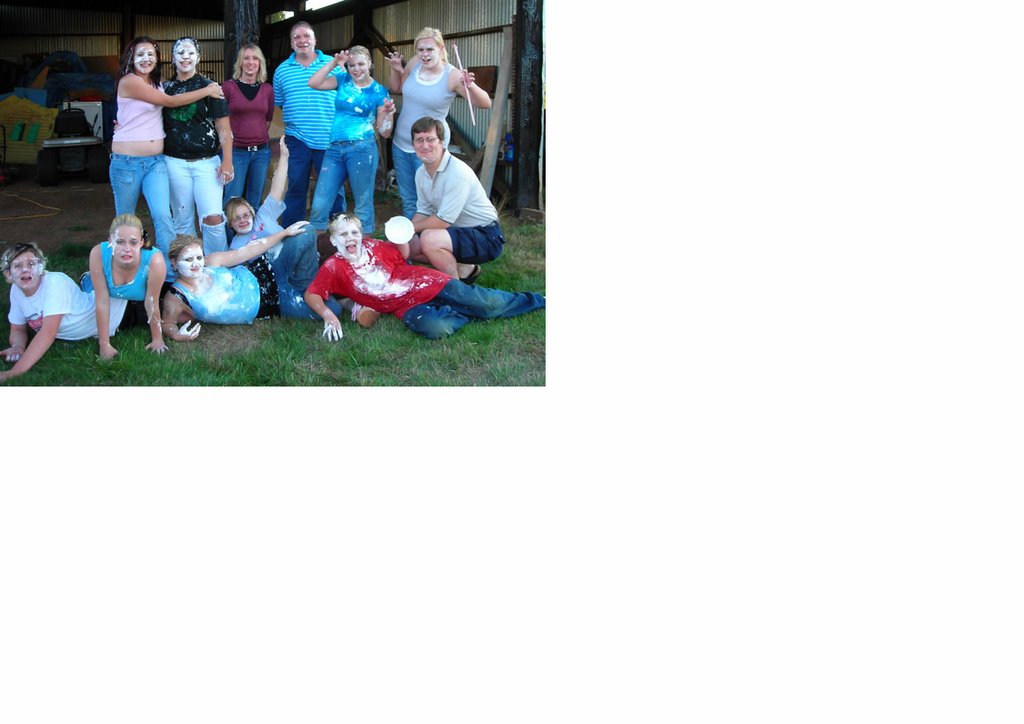
Longview United Methodist Youth joined the Vancouver District "Cool Whip Night"

Did you know that cool whip makes a very effective hair gell?

Monday, September 18, 2006

Sermon Notes Sunday September 17

Mark 2:1-12

Home is where the Heart is.

I have a number of places that I might call “home.” Partly it depends on who you are talking to and where you are at the time. Sometimes when I lived in Dallas I would call home Seattle simply because it was easier than saying Rochester, WA and then explaining no, not Washington D.C., WA State.

Today’s Gospel Reading tells us that Jesus is at home. We don’t often think about Jesus being at home. Often we think of Jesus wondering around with people following him. Yet, we know that there were times when Jesus had a place he called home. In the Gospel of Mark that home is Capernaum.

Capernaum is a small fishing village along the Sea of Galilee. The remains of the first century place are visible today and there is a church that hovers above the reported site of this home described in the Gospel of Mark. All that remain are some stone foundations but you can get a sense of the tight community that existed in the time of Jesus. The town itself is smaller than our 5 acres at LUMC. The “streets” or walkways are pretty narrow between the houses. It wouldn’t take a whole lot of people to block the entrance.

The paralytic’s friends are pretty audacious. Climbing on the roof and ripping it apart so that they could lower their friend down to Jesus. They go to every effort to be sure that their friend might be made whole by Jesus.

I imagine that as the paralytic’s friends lowered him down to Jesus they were anxious and hopeful. With each effort they were brining him closer to his best hope for healing. I imagine they were anxious, wondering if this was actually going to work. What if it didn’t work? What if their friend is never healed?

The healing itself is extraordinary, Jesus says “your sins are forgiven.” What does sin have to do with his paralysis? There is this folk religious idea among some in ancient Judaism that sin is what causes our troubles. So some in the village and perhaps, this man himself, believed that it was his sin that caused his paralysis. So Jesus welcomes and heals him by declaring that his sin is forgiven.

I don’t know if it was sin that paralyzed this man but I do know that there are times when I have been paralyzed with guilt. You know those moments when you are so overcome with the guilt of your actions that you don’t know what to do next, you simply wish you could make the situation go away.

Jesus knows that the healing we need is not only physical healing but the healing that we need is spiritual. We need to come to Jesus and be released from sin.

Sometimes all we need to find this healing is to come to a place where Jesus is. Hopefully, we won’t have to tear the roof off the building, but if that is what it takes, may we have the strength to do it. Home is where we are free from sin and death and free to live and love!


What effort are you willing to go to so that your friends might come closer to Christ?

What Sin do you desire for Christ to heal in your life today?

Comments

I received a comment on the blog and I posted it with some hesitation, but I thought it was good for a discussion. The comment is attached to the post "Love your enemies." The comment was anonymous and I was hesitant to post a comment when someone refused to put their name to it. If this becomes a problem in the future I will refuse comments without names.

What saddens me about the poster's comments is the attempt to win points and the concluding attempt to save my soul.

It would have been more helpful had the poster desired to enter into a dialogue about those things that we obviously disagree about. A dialogue is an open discussion where we do not enter it trying to score points and to "win" but we enter the discussion in an effort to listen and learn.

The poster states, "And the Bible teaches that homosexuality is wrong. As a minister, you cannot ignore one section of the Bible in favor of another and ignore it in the name of truth and justice and your quest to "welcome" all people." I am not ignoring the Bible. I take the Holy Scriptures seriously as the foundation for my faith. I read these Scriptures with all the gifts God has given me with my ability to reason, with the traditions of the church and with my religious experience. The Bible's statements about sexuality are not clear to me. Our English translations of Hebrew and Greek are not universally agreed upon. We have some idea but not a clear understanding of what Paul was talking about when he used the words,
"arsenokoites" or "malakos." Is Paul condemning male prostitution or pedophilia or consentual loving partnerships? A strong case can be made for the first two, in which case I agree totally. Prostitution is immoral. Pedophilia a heinous immoral act. Is that the same as sex in a loving partnership between two people of the same gender? I don't think it is.

Grace and Peace,

Bruce

Wednesday, September 06, 2006

Sermon Notes, Sunday September 3, 2006

Welcome Home
Genesis 18:1-8

When have you been a stranger and welcomed by another? If you are like me those moments when someone has received you as a special guest have left an impression on you. It can be a humbling experience. Hospitality can change your life.

Interestingly the word in the New Testament for hospitality is philoxenia or “love of the stranger.” New Testament people are called to love the stranger, not fear them. When Jesus teaches about hospitality it is about loving one another.

Luke 14 Jesus is the guest at a Pharisee’s house. He offers advice about hospitality. “do not sit at the place of honor”, “do not invite your friends”, “invite the poor, the crippled, the lame.”

Romans 1:11-12 Paul says, “For I am longing to see you so that I may share with you some spiritual gift to strengthen you or rather so that we may be mutually encouraged in each other’s faith, both yours and mine,”

In welcoming one another our faith is strengthened. We have shared a number of moments where our love of the stranger has strengthened the faith of another. Sometimes it was for the one who was welcomed, sometimes it was for the one welcoming, sometimes it was mutual.

It will take continued effort to welcome the stranger into our community of faith. Each of us must be willing to love the stranger. You never know when the next member of LUMC will sit for the first time as a guest in “your” pew.

You are the welcoming team for LUMC. There are some items that it would be good for us to remember as we become ready to welcome the stranger.

Gathering and greeting time. It is vital that the entrance to the church be a positive experience for our guests. Some of our guests have been building up the courage to come to a church for a long time. Some of their experiences in church have been harmful and they come wounded and fragile. Some want to talk with many people, some simply want to sit down. We must find the right balance of attentiveness and giving space.

Make an effort to remember the names of those who sit near to you. NAME TAGS are helpful for this. Some people are visual learners and need to see your name as well as hear you say it.

“Passing the Peace” or “Holy hub bub” as I have heard it called. Again we need to have the appropriate balance of welcome without smothering.

It is important that you let us know that you were in attendance but also to set the example of writing your address and other contact information in the attendance pads when they are passed out. With this information we are able to deliver a gift for our visitors and inform them about the ministry of LUMC.

“Fellowship Time” can be one of our strengths but we need to be diligent. It is tempting to sit with our friends and catch up, yet when that happens we might be unintentionally forming “cliques” that exclude others.